
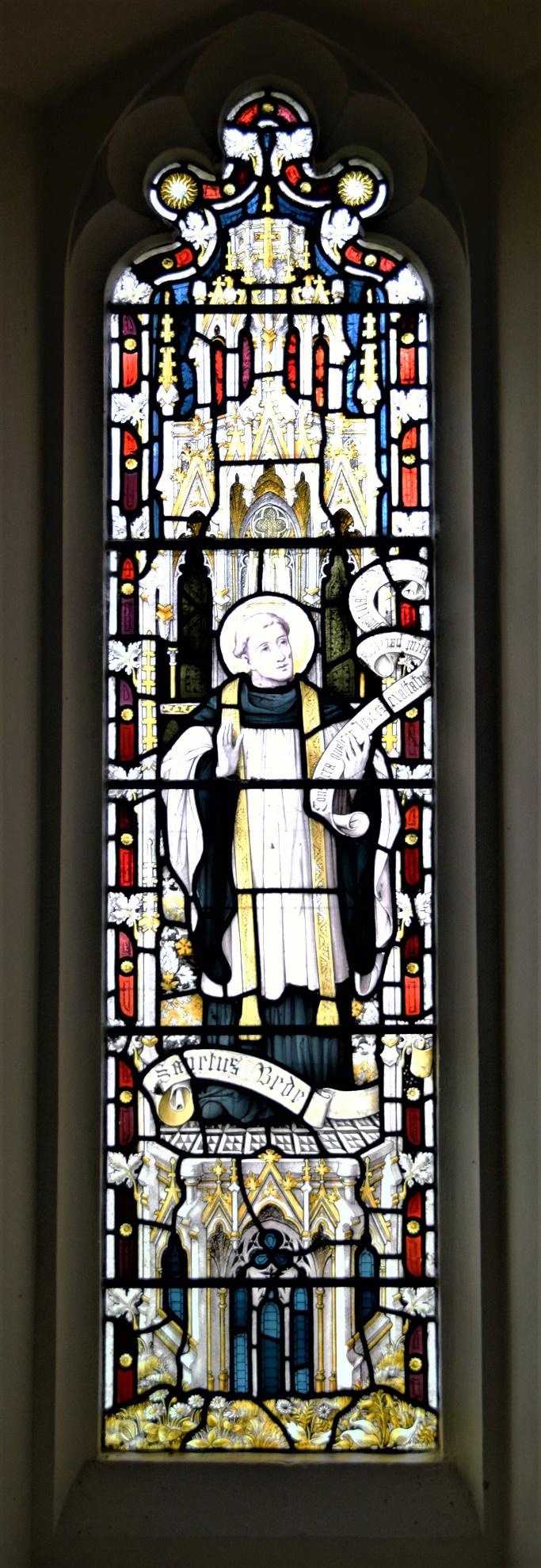
 In the window by the pulpit is Venerable Bede, the representative of a learned clergy. His last work – the translation of the Gospel by St. John – he finished while dying; his life had been an interpretation of the last recorded injunction of his Lord, “Follow thou Me”. He is an example for all succeeding generations of Ministers in the Church.
Venerable Bede (Sanctus Bede) also known as Saint Bede and Bede the Venerable was an English Benedictine monk at the monastery of St. Peter and its companion monastery of St. Paul in the Kingdom of Northumbria of the Angles (contemporarily Monkwearmouth–Jarrow Abbey in Tyne and Wear, England).
Born in 672/3 AD on lands belonging to the twin monastery of Monkwearmouth-Jarrow, Bede was sent to Monkwearmouth at the age of seven and later joined Abbot Ceolfrith at Jarrow, both of whom survived a plague that struck in 686, an outbreak that killed a majority of the population there. While he spent most of his life in the monastery, Bede travelled to several abbeys and monasteries across the British Isles, even visiting the archbishop of York and King Ceolwulf of Northumbria.
He is well known as an author, teacher and scholar, and his most famous work, Ecclesiastical History of the English People, gained him the title “The Father of English History”. His ecumenical writings were extensive and included a number of Biblical commentaries and other theological works of exegetical erudition. Another important area of study for Bede was the academic discipline of computus, otherwise known to his contemporaries as the science of calculating calendar dates. One of the more important dates Bede tried to compute was Easter, an effort that was mired in controversy. He also helped popularize the practice of dating forward from the birth of Christ (Anno Domini – in the year of our Lord), a practice which eventually became commonplace in medieval Europe. Bede was one of the greatest teachers and writers of the Early Middle Ages and is considered by many historians to be the most important scholar of antiquity for the period between the death of Pope Gregory I in 604 and the coronation of Charlemagne in 800.
In 1899, Pope Leo XIII declared Bede a Doctor of the Church. Doctor of the Church (Latin doctor: “teacher”), also referred to as Doctor of the Universal Church, is a title given by the Catholic Church to saints recognized as having made a significant contribution to theology or doctrine through their research, study, or writing. Bede is the only native of Great Britain to achieve this designation; Anselm of Canterbury, also a Doctor of the Church, was originally from Italy. Bede was moreover a skilled linguist and translator, and his work made the Latin and Greek writings of the early Church Fathers much more accessible to his fellow Anglo-Saxons, which contributed significantly to English Christianity. Bede’s monastery had access to an impressive library which included works by Eusebius, Orosius, and many others.
Almost everything that is known of Bede’s life is contained in the last chapter of his Ecclesiastical History of the English People, a history of the church in England. It was completed in about 731, and Bede implies that he was then in his fifty-ninth year, which would give a birth date in 672 or 673. Bede gives his birthplace as “on the lands of this monastery”. He is referring to the twinned monasteries of Monkwearmouth and Jarrow, in modern-day Wearside and Tyneside, respectively. Except for a few visits to other monasteries, his life was spent in a round of prayer, observance of the monastic discipline and study of the Sacred Scriptures. Bede died on the Feast of the Ascension, 26 May 735, on the floor of his cell, singing “Glory be to the Father and to the Son and to the Holy Spirit” and was buried at Jarrow.